
What Can Humans Learn From Trees?
Aug 19, 2026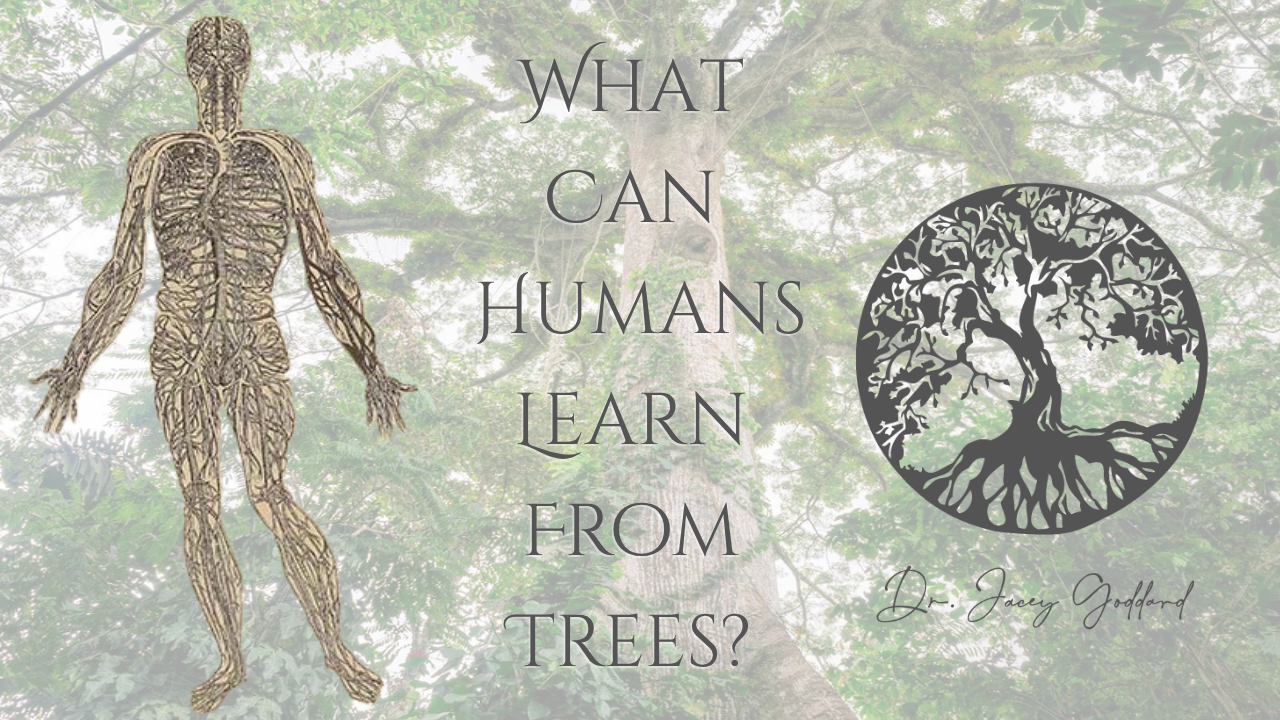
You might have noticed that I have a tree of life image for my logo. The tree metaphor is something that clicked for me back when I was presenting at a conference workshop on the topic of “Extremities”. In medicine, the upper and lower extremities of the body are the arms and legs. What I realized in the moment was that our human body has roots (legs) and branches (arms) much like a tree. Even our immense nervous system is described in anatomy texts as having various branches as each nerve has its own specific name and location. In the image, you can see how extensive the nervous system is from the top of our head to the tips of our fingers and toes. As I contemplated it a bit more, I started to realize how our whole body is quite tree-like. In fact, since we have a trunk that connects the roots and branches, that is essentially the main part of the body and that like a tree, everything connects through that trunk. We can learn from a tree in its beauty, its stability, its stillness, and its interconnectedness with all of creation.
But really, why am I really talking about all of the metaphorical reasons humans are like trees?? It's because trees have lessons for us. Trees provide shelter and wood for the homes we live in. They take care of the environment when they clean the air. They provide shade. They receive hugs from “tree huggers”. There are so many cool things about trees and if we take a moment to consider, they can help us to experience our own human interconnectedness.
Stability
If you’ve done yoga, you may have experienced Tree Pose. In Tree Pose, you shift your weight to one foot, and place the sole of your other foot against your inner calf or thigh. Bring your hands to your heart or reach your arms up like branches to build focus, stability, and lower body strength. When I do tree pose, it really helps to push my attention down into the ground below me as if my “roots” are going into the earth. When I do this, I wobble less, and I feel much more stable standing only on one foot. I find it really interesting that thousands of years ago, someone else thought the body had similar properties to a tree.
The metaphor doesn't end there however, because trees have a lot of wisdom to offer us, and set a beautiful example for us of how to be better humans. Think of a tree with deep roots...strong roots give the tree strength and stability in strong winds and storms, they absorb water and nutrients from the earth, and are the foundation of the tree as a whole. As humans, the roots of our tree are our feet, legs, and pelvis. They too are our foundation. If we can use our roots the way a tree does, we also have strength and stability. When we connect to our “roots” we’re grounded in our body, we’re energetically supported by the earth, and we have better access to all that is within us.
The point that I'm trying to make here is that just like a tree we have a whole body to live in. If we live just in our branches, our heads or minds, we can be top heavy. We can get so much information that it can be overwhelming. The storms of life can blow us over. When we remember to live fully in our “tree”, we feel our roots as well as our branches, we’re grounded and connected to the earth, we’re in our “whole self”, and we have strength and stability. Take a moment, drop down into your body, and sense the “roots” of your nervous system, supported by the earth beneath you. Can you feel a sense of inner balance? Now stay with that feeling as you read on.
Interconnectedness
I took several Botany classes in college, where we looked at the inner anatomy of plants and trees. We studied “xylem and phloem”. Xylem moves water and minerals up from the roots. Phloem moves food and sugars up and down to all the parts of plants. They’re contained in “vascular” bundles to keep the plant alive. So trees have vascular structures just like our blood vessels, that carry the sap, the life giving “syrup” that is the living vitality of the tree.
Our human “branches” are the top part of our body, our arms and head basically. The branches of a tree absorb the light of the sun for food through photosynthesis, they connect to the sky and the air, and release water into the air through transpiration. This is happening all of the time though an invisible flow of fluid exchange. As humans we aren’t exchanging food and water through our branches but we are exchanging and receiving information, energy, and even light from the heavens in a spiritual way when we’re open to it.
In nature, the roots of trees are connected to one another deep in the earth and communicate through the fungal mycelium structures in intricate ways. Individual trees relate to one another via their branches and even appear to respect one another as they share the space in the sky through a phenomenon called “crown shyness". Darwin used the "tree of life" metaphor to show how all species on Earth branch out from shared common ancestors. In nature there are infinite fractal microcosm and macrocosm repeated interconnectedness from the smallest quarks and particles to the immense galaxies that are so expansive they are beyond our human comprehension.
Stillness
When we look at a tree or spend time in nature, we remember to breathe and slow down. We are awestruck by the incredible beauty in nature. Trees stand strong and still, and seem patient despite our human rushing about. The gift of the tree is many faceted and has many lessons on mystical and spiritual levels where they are used to describe divine structure, creation, and the spiritual path of ascent. The Buddha was said to become enlightened while sitting under a tree.
The Tree of Life is present in many cultures and religions with metaphorical lessons about an individual in relation to all of Creation. In Norse traditions there is a cosmic world tree connecting heaven, earth, and the underworld. There are various Native American stories about the Tree of Life including how the roots and branches connect the tree to Mother Earth and Father Sky. In the bible, a person is “like a tree planted by streams of water, which yields its fruit in season and whose leaf does not wither— whatever they do prospers”.
Centering
While I may love the many metaphors that trees offer us, the thing I love most is what happens when we literally feel our own tree. Are you still feeling your tree? Take another moment to drop down into your lower body and feel your “roots” connecting deep into the earth. Now sense your branches in your head and upper body feeling the light of the sun. Next, sense your trunk that holds your heart and organs and connects your roots and branches. Feel the wholeness of the “tree” that is your body. Finally, no matter where you are as you read this, consider how you are one tree in the forest of all of nature. We’re always connected and sometimes we just need to take a moment and center ourselves in our own “treeness” in relation to the universe. It only takes a moment and it feels good. It's a kind of shift in perspective that can help us to remember ourselves, find stability within, and be still and know.
If you liked this article and if you’re now dropped into your body and feeling your own embodied tree, perhaps go back and read this article one more time, feeling your tree and all of the powerful ways your human tree offers you strength and wisdom in your life. Then practice feeling your “Tree” as you go through each day. The more you feel yourself grounded in your own roots, the more calm your nervous system will be, the less reactive, the more focused,the more connected to your inner wisdom.
And if feeling your “Tree” feels good to you, you can use the code TREE for 30% off my master class, Healing From Within, where there are several guided Tree Experiences to calm your nervous system, rewire unhelpful patterns, and experience the stillness and oneness of nature for better health and wellness on many levels.